
Every rejected claim tells a story.
Sometimes it’s a missing modifier. Sometimes it’s an incorrect diagnosis code. Sometimes it’s an eligibility verification issue that should have been identified before the patient was even seen.
The problem is not that these errors occur.
The problem is that many organizations discover them too late.
By the time a claim is rejected, staff must investigate the issue, correct the error, resubmit the claim, and follow up with the payer. What could have been a clean reimbursement becomes additional work, delayed cash flow, and increased administrative burden.
For many healthcare organizations, the real revenue leak isn’t denials.
It’s preventable errors that leave the billing department unchecked.
Pain Point #1: Claims Rejected Before Submission
One rejected claim may seem insignificant.
Hundreds of rejected claims each month create a completely different financial picture.
Common causes include:
- Missing patient demographics
- Invalid insurance information
- Eligibility issues
- Missing authorizations
- Incorrect payer details
- Incomplete documentation
These issues can prevent claims from moving forward long before reimbursement begins.
How many claims is your team correcting every week because basic information wasn’t verified upfront?
Pain Point #2: Coding Errors Discovered Too Late
Coding errors rarely become expensive because they happen.
They become expensive because they are discovered after submission.
Common examples include:
- CPT and ICD-10 mismatches
- Incorrect modifiers
- Unsupported E/M levels
- Medical necessity concerns
- Outdated coding references
Every coding correction requires rework.
Every reworked claim delays reimbursement.
If you audited the last 100 claims submitted by your organization, how many would require coding corrections today?
Pain Point #3: No Structured Pre-Submission Quality Check
Many organizations rely on billing software to identify errors.
Technology is valuable.
However, software alone cannot replace experienced medical billing and coding review.
Without a structured quality audit process:
- Documentation issues go unnoticed
- Coding inconsistencies increase
- Payer-specific requirements are missed
- Denial risk grows
The result is a reactive revenue cycle instead of a proactive one.
Why High-Performing Organizations Focus on Prevention?
The most effective revenue cycle teams don’t wait for denials.
They focus on prevention.
Their process includes:
Eligibility Validation
Insurance and authorization verification before service.
Coding Review
CPT, ICD-10, modifier, and documentation validation.
Claim Scrubbing
Automated checks against payer edits and billing rules.
Quality Audits
Human review to identify issues technology may miss.
This layered approach helps organizations submit cleaner claims and reduce avoidable rework.
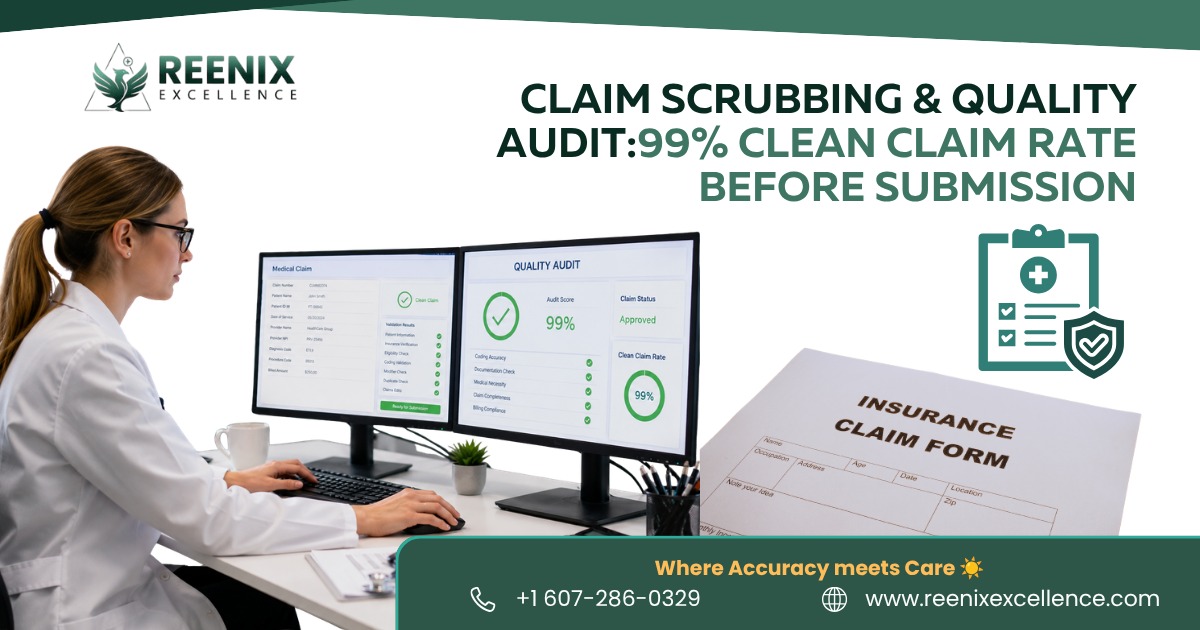
What a 99% Clean Claim Rate Really Means?
A high clean claim rate is not simply a billing metric.
It means:
- Fewer claim rejections
- Faster reimbursements
- Less staff rework
- Lower denial volume
- Better cash flow visibility
- More efficient revenue cycle operations
Most importantly, it means fewer revenue interruptions.
The 10-Point Claim Quality Checklist
Before every claim is submitted, ask:
✅ Insurance eligibility verified
✅ Patient demographics confirmed
✅ Authorization requirements completed
✅ CPT codes validated
✅ ICD-10 diagnoses verified
✅ Modifier usage reviewed
✅ Medical necessity documented
✅ Provider notes completed
✅ Payer-specific edits reviewed
✅ Final quality audit completed
Missing even one of these items can create avoidable reimbursement delays.
Warning Signs Your Organization Needs Claim Scrubbing Medical Billing Services
You may benefit from a claim quality assessment if:
- Claim rejections are increasing
- Staff spend significant time on corrections
- Denial rates remain elevated
- Reimbursements are slowing down
- Accounts receivable continues to grow
- Coding issues are discovered after submission
- Visibility into claim quality is limited
If any of these challenges sound familiar, the issue may not be your payer.
The issue may be the quality of claims being submitted.
Free Claim Quality Assessment:
Many organizations do not know how much revenue is being delayed until they review their claims process.
Reenix Excellence offers a complimentary claim quality assessment designed to identify:
- Common rejection triggers
- Coding accuracy gaps
- Documentation deficiencies
- Workflow inefficiencies
- Opportunities to improve clean claim rates
Our team reviews your billing workflow and highlights areas where claim scrubbing medical billing services and quality audits can improve reimbursement performance.
What You’ll Receive
✔ Claim Quality Review
✔ Billing Process Evaluation
✔ Denial Risk Assessment
✔ Revenue Opportunity Analysis
✔ Actionable Recommendations
Find Out What’s Slowing Down Your Claims:
If claims are being rejected before submission, coding errors are being discovered too late, or your organization lacks a structured pre-submission quality review process, now is the time to identify the root cause.
Request your free claim quality assessment and discover how cleaner claims can lead to faster reimbursements and stronger revenue cycle performance.
Sources & References
- Healthcare Financial Management Association (HFMA) – Revenue Cycle Management Resources
- Centers for Medicare & Medicaid Services (CMS) – Claims Processing and Billing Guidance
- American Medical Association (AMA) – CPT® Coding Resources
- CAQH Index – Administrative Simplification and Claims Processing Reports
- Medical Group Management Association (MGMA) – Practice Management Insights
- AAPC – Medical Coding and Compliance Resources


Comments are closed