

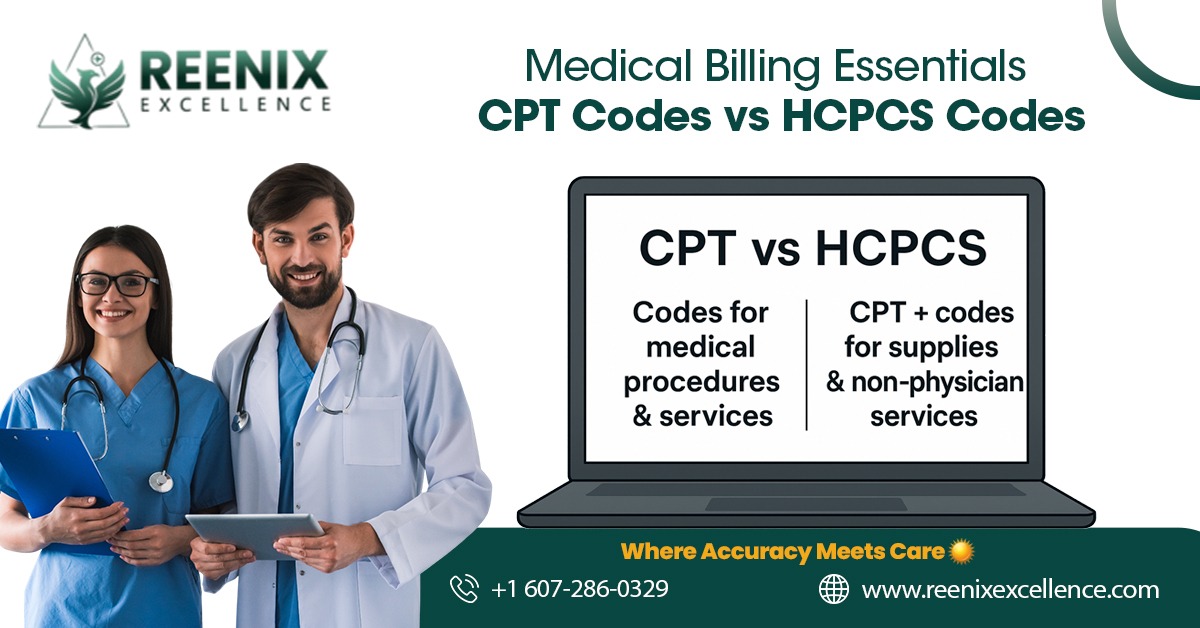
Accurate medical coding is the backbone of successful healthcare reimbursement. Whether you’re running a physician’s office, a specialty clinic, or a hospital, understanding the nuances between CPT codes and HCPCS codes is essential. These codes are the foundation of claim submissions, and even minor mistakes can lead to denials, compliance risks, and revenue loss.
In this blog, we’ll break down the key differences between CPT and HCPCS codes, explain why they matter, and how Medical Billing and Coding Services play a vital role in maximizing reimbursement and compliance.
What Are CPT Codes?
Current Procedural Terminology (CPT) codes are developed and maintained by the American Medical Association (AMA). These five-digit numeric codes describe the procedures and services that healthcare providers deliver during patient visits.
CPT codes are categorized into three types:
- Category I: Standard procedures and services (e.g., office visits, surgeries, radiology, lab tests).
- Category II: Performance measurement codes (used for tracking outcomes, not for reimbursement).
- Category III: Temporary codes for emerging technologies and procedures.
CPT codes are primarily used for billing to private payers, Medicaid, and Medicare.
What Are HCPCS Codes?
Healthcare Common Procedure Coding System (HCPCS) codes are developed by the Centers for Medicare & Medicaid Services (CMS). HCPCS includes two levels:
- Level I: Identical to CPT codes (numeric codes developed by AMA).
- Level II: Alphanumeric codes that represent non-physician services and products not covered in CPT codes.
Level II HCPCS codes are used for:
- Durable Medical Equipment (DME)
- Ambulance services
- Prosthetics and orthotics
- Drugs administered outside the hospital
- Supplies like wound dressings or catheters
These codes are crucial when billing Medicare, Medicaid, and other government programs.
CPT vs HCPCS: Key Differences at a Glance
| Feature | CPT Codes | HCPCS Codes |
| Governing Body | American Medical Association (AMA) | Centers for Medicare & Medicaid Services (CMS) |
| Format | 5-digit numeric codes | Alphanumeric (one letter + 4 numbers) |
| Purpose | Procedures and services performed by providers | Products, supplies, and non-physician services |
| Usage | Commercial payers, Medicare, Medicaid | Medicare, Medicaid, and other government plans |
| Update Frequency | Annually by AMA | Quarterly by CMS |
Why the Difference Matters in Medical Billing?
Failing to use the correct code can result in:
- Claim denials or delays
- Underpayment or overpayment
- Compliance audits
- Revenue leakage
A simple coding error—like using a CPT code for a service that requires an HCPCS Level II code—can disrupt your revenue cycle management and require time-consuming corrections.
This is where professional Medical Billing and Coding Services are critical. They have trained coders who understand the correct use of each code set, ensuring proper claim submissions.
The Role of Medical Coding Services in Accuracy and Compliance
As coding guidelines grow more complex, it’s no longer feasible for most practices to handle them in-house. Medical Coding Services bring several advantages:
1. Specialized Knowledge
Trained medical coders understand when to use CPT vs HCPCS codes. They stay current on updates from both the AMA and CMS.
2. Coding for Specialty Services
Specialties like oncology, anesthesia, and radiology often use both CPT and HCPCS codes in the same claim. Expert coders ensure correct pairing and sequencing to avoid denials.
3. Audit Preparedness
Proper documentation and accurate code selection reduce audit risks. Certified coding teams review each claim for compliance.
4. Improved Cash Flow
By reducing errors and denials, Medical Coding Services help practices receive payments faster and in full.
FAQ:
- What is the difference between CPT and HCPCS codes?
CPT codes are used for medical procedures by doctors, while HCPCS codes are used for equipment, supplies, and services like ambulances, especially for Medicare billing.
2. Who uses HCPCS codes?
HCPCS codes are mainly used by Medicare, Medicaid, and other federal healthcare programs to bill for non-physician services.
3. Do I need both CPT and HCPCS codes?
Sometimes, yes. Providers often use both if they perform a procedure (CPT) and provide medical supplies (HCPCS) in the same encounter.
How Outsourcing Supports Better Billing Accuracy?
Working with an outsourcing Medical Billing and Coding Service provider brings long-term value to healthcare practices, hospitals, and specialty clinics.
1. Scalability
Whether your practice is growing or managing multiple locations, outsourced teams can scale coding support without sacrificing accuracy.
2. Cost Efficiency
You avoid the costs of hiring, training, and retaining in-house coding experts.
3. Faster Updates
Outsourced providers track every change in CPT and HCPCS codes and apply them immediately—so your billing always stays current.
4. Technology Integration
Professional billing partners use industry-standard software that integrates with your EHR and helps automate coding workflows for better accuracy.
The Impact on Revenue Cycle Management
Accurate coding directly affects every stage of the revenue cycle management process:
- Front-end: Proper code selection helps with correct insurance verification and preauthorization.
- Mid-cycle: Accurate claims reduce rework and shorten payment timelines.
- Back-end: Fewer denials and faster reimbursements support a healthier cash flow.
With an experienced partner like a trusted Medical Billing and Coding Service provider, practices can streamline their revenue cycle, reduce administrative burden, and improve profitability.
Conclusion: Get the Codes Right to Get Paid Right
Understanding the difference between CPT and HCPCS codes is more than a technicality—it’s a fundamental part of effective billing. Mistakes not only delay payments but can put your practice at compliance risk.
Partnering with a qualified outsourcing Medical Billing and Coding Service provider can help your organization:
- Improve claim accuracy
- Stay compliant with coding updates
- Reduce denials and rework
- Optimize your entire revenue cycle management
If your team is spending more time fixing coding issues than serving patients, it may be time to bring in the experts.
Need Help with Accurate and Compliant Medical Coding?
Contact Reenix Excellence — a leading Medical Billing Company.
Our expert team delivers reliable Medical Coding Services that support your compliance, boost claim accuracy, and strengthen your revenue cycle management.
Reach out today and let us help you simplify your billing and maximize reimbursement.


Comments are closed