
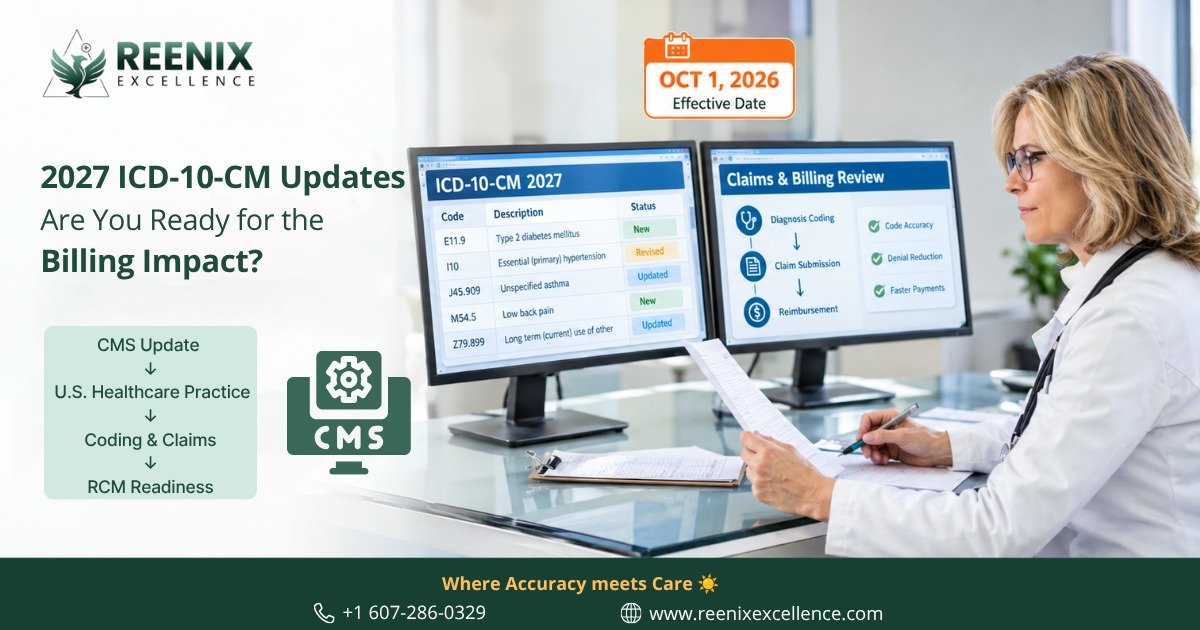
October 1, 2026 brings another important coding transition for U.S. healthcare practices.
The FY 2027 ICD-10-CM code set becomes effective October 1, 2026, and should be used for healthcare services provided through September 30, 2027. The release replaces the April 1, 2026 FY 2026 release.
For physicians and practice administrators, however, there is a bigger question than whether the new codes have been loaded into the system:
Is your billing and revenue-cycle workflow ready for what happens after October 1?
Because a coding transition doesn’t stop at coding.
It moves through documentation, claim preparation, submission, payer response, denials, payment posting, and ultimately A/R.
For practices already managing billing backlogs, recurring denials, or aging accounts receivable, the FY 2027 transition creates a timely opportunity to examine whether the entire revenue cycle is ready—not just the code set.
What Is Changing With the FY 2027 ICD-10-CM Update?
CMS and CDC have released the FY 2027 ICD-10-CM files ahead of the October 1 implementation date.
The official resources include FY 2027 code descriptions, addenda, code tables and indexes, a conversion table, POA-exempt codes, and the FY 2027 ICD-10-CM Official Guidelines for Coding and Reporting.
CMS has separately reminded healthcare professionals that the FY 2027 ICD-10 codes become effective for patient encounters and discharges on or after October 1, 2026.
And this is not relevant only to Medicare practices. CMS states that ICD-10 applies to parties covered by HIPAA, not simply healthcare providers billing Medicare or Medicaid.
So the immediate task is clear:
U.S. healthcare practices need to be prepared for the FY 2027 code set beginning October 1.
But what does that actually mean operationally?
How Can the 2027 ICD-10-CM Update Affect U.S. Healthcare Practices?
For a physician, practice owner, or administrator, ICD-10-CM may appear primarily to be a coding-team responsibility.
In reality, the information travels much further through the revenue cycle:
Patient Encounter → Documentation → Coding → Claim Submission → Payer Response → Payment or Denial → A/R Follow-Up
The FY 2027 Official Guidelines contain general coding conventions and chapter-specific guidance, including requirements concerning code assignment, level of detail, signs and symptoms, combination codes, laterality, and documentation.
That means preparation is not simply a matter of downloading a new code file.
Practices need to consider whether their coding resources, relevant workflows, systems, and personnel are prepared to work with the applicable FY 2027 requirements.
And that leads to the next question:
What happens when these claims start moving through your billing operation?
Could the Transition Add Pressure to an Already Busy Billing Operation?
The FY 2027 update does not automatically mean your practice will experience denials or delayed reimbursement.
But if your revenue cycle is already under pressure, an annual coding transition is a logical time to examine the weaknesses that already exist.
For example:
Your coding team may be handling current claims while reviewing relevant FY 2027 guidance.
Your billing staff may be submitting new claims while still following older unresolved accounts.
Your team may be addressing individual claim issues without having enough visibility to recognize a recurring pattern.
Your practice administrator may know how much A/R is outstanding—but not immediately know why particular accounts remain unresolved.
This creates an important distinction.
Being ready to submit a claim is not the same as being ready to manage what happens after submission.
If your practice already experiences recurring claim rework, billing backlogs, aging A/R, or limited visibility after claims leave the system, October 1 provides a natural checkpoint for reviewing those processes.
The question practice leaders should ask is:
If something requires attention after October 1, how quickly will our revenue cycle identify it?
Coding Readiness Is Only Half the Question. Is Your RCM Ready?
A practice can update its coding resources and still have weaknesses elsewhere in the revenue cycle.
Consider the complete workflow:
Documentation → Coding → Claim Submission → Payer Response → Denial Management → Payment Posting → A/R Follow-Up → Reporting
Now look beyond October 1.
A claim requires additional attention.
Who identifies it?
Several claims begin showing similar issues.
Can your billing operation recognize the pattern?
An unresolved account moves further into A/R.
Who follows it?
Leadership reviews the A/R report.
Can they see why those accounts remain outstanding and what action is being taken?
Those questions have very little to do with downloading the FY 2027 code set.
They have everything to do with Revenue Cycle Management readiness.
Is Your Revenue Cycle Ready for October 1?
Before the FY 2027 transition, practices can use a simple readiness check:
- Are the FY 2027 ICD-10-CM resources available to the appropriate staff?
- Has relevant FY 2027 coding guidance been reviewed?
- Are coding and billing systems prepared for the October 1 transition?
- Is there clear responsibility for monitoring claims after submission?
- Can recurring claim or denial patterns be identified?
- Are unresolved claims receiving consistent follow-up?
- Is aging A/R being actively monitored?
- Can practice leadership understand why accounts remain outstanding?
The first few questions evaluate coding readiness.
The remaining questions evaluate something broader:
RCM readiness.
If your practice is confident about the first group but less confident about the second, the October 1 transition may be the right time to examine the wider revenue-cycle operation.
When Does an RCM Review Make Sense?
You don’t necessarily need to wait for a coding transition to review your revenue cycle.
But October 1 provides a useful trigger.
If your practice is already experiencing:
Recurring denials
Growing or aging A/R
Billing backlogs
Repeated claim rework
Limited visibility after claim submission
Inconsistent follow-up on unresolved claims
then the more important question may no longer be:
“Are we prepared for the FY 2027 codes?”
It may be:
“Is our current RCM process giving us enough visibility and follow-up?”
And that is where the conversation changes from coding compliance to revenue-cycle performance.
Where Reenix Excellence Fits
At Reenix Excellence, we support U.S. healthcare practices across the broader revenue cycle, including medical coding, medical billing, claim submission, denial management, payment posting, and A/R follow-up.
Our perspective therefore goes beyond whether a claim was coded and submitted.
We also look at what happens after submission.
Is the claim moving through the workflow?
Does it require additional attention?
Are similar issues recurring?
Are unresolved claims being followed?
Why is A/R aging?
What information does practice leadership need to see?
For practices preparing for the FY 2027 transition, that means looking at both sides of readiness:
Is your coding workflow prepared for October 1?
And:
Is your revenue cycle prepared for what happens next?
That second question can be especially important for growing practices or organizations where internal billing resources are already managing significant day-to-day workload.
Frequently Asked Questions
1. When do the FY 2027 ICD-10-CM codes take effect?
FY 2027 ICD-10-CM codes should be used for healthcare services provided from October 1, 2026 through September 30, 2027. The October 1 release replaces the April 1, 2026 FY 2026 release.
2. Do the 2027 ICD-10-CM updates affect U.S. medical practices?
Yes. CMS states that ICD-10 applies to parties covered by HIPAA, not only healthcare providers billing Medicare or Medicaid.
3. What should practices review before October 1?
The official FY 2027 resources include code descriptions, addenda, code tables and indexes, a conversion table, POA-exempt codes, and the FY 2027 Official ICD-10-CM Coding Guidelines. Practices should use the official resources applicable to their coding activities and review relevant workflows ahead of implementation.
4. Is updating ICD-10 codes enough for RCM readiness?
Updating to the applicable code set addresses the coding transition. RCM readiness is broader and includes how the practice manages claims, payer responses, denials, payment posting, unresolved accounts, A/R follow-up, and reporting after submission.
October 1 Is a Coding Deadline. It Can Also Be an RCM Checkpoint.
The 2027 ICD-10-CM updates are coming.
Your codes may be updated.
Your systems may be prepared.
Your coding team may be ready.
But ask one more question:
Is your revenue cycle ready for what happens after the claim is submitted?
If recurring denials, aging A/R, billing backlogs, or limited claim visibility are already putting pressure on your practice, the FY 2027 transition provides a timely opportunity to review the broader workflow.
Request a Complimentary Revenue Cycle Assessment
Reenix Excellence can review your coding-to-payment workflow to identify areas that may require closer attention across medical billing, claims, denial management, A/R follow-up, and revenue-cycle visibility.
Don’t start by asking whether you need to change your billing model. Start by identifying where your revenue cycle is under pressure.
References
- CDC/NCHS — ICD-10-CM Files and FY 2027 Release — Confirms the October 1, 2026 effective date, September 30, 2027 end date, and replacement of the April 2026 FY 2026 release. CDC
- CMS — ICD-10 and FY 2027 ICD-10-CM Files — Official FY 2027 files and CMS implementation information. Centers for Medicare & Medicaid Services
- CMS/NCHS — FY 2027 ICD-10-CM Official Guidelines for Coding and Reporting — Official FY 2027 coding conventions and guidance. Centers for Medicare & Medicaid Services
- CMS Medicare Learning Network — FY 2027 ICD-10 Codes — CMS notice on FY 2027 codes effective October 1, 2026.


Comments are closed